2026 Incident Management Software Shortlist: What Changed This Year
Disclosure: ITOC360 is our product. It appears in the table below and we say so directly, without pretending the other events on this page favor us more than they do.
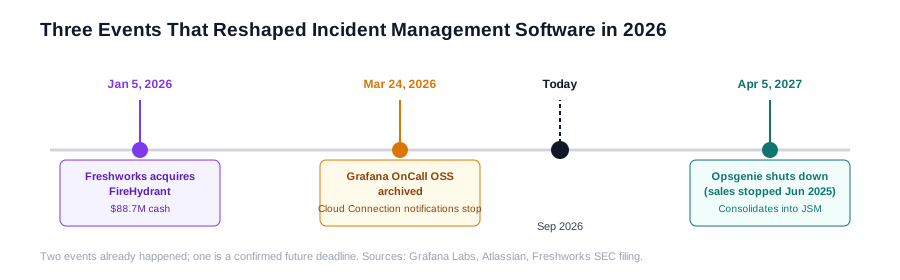
Quick answer: If you evaluated incident management software even a year ago, your shortlist is already out of date. Three vendor-side events reshaped the landscape in 2026, and none of them were feature launches: Grafana OnCall's open-source edition was archived in March, Atlassian confirmed Opsgenie's shutdown for April 2027, and Freshworks bought FireHydrant for $88.7 million in January. None of that shows up on a features comparison, and all three change which name on your list is still a safe default.
How we verified this: Each event below is checked against the vendor's own announcement or an SEC filing, not a secondary blog post repeating older coverage. Full sources are listed at the bottom. Tell us if something here changes before our next review in December.
Grafana OnCall: from open source to maintenance mode
What actually changed
Grafana OnCall's open-source, self-hosted edition was archived on March 24, 2026.¹ The repository now takes only critical CVE patches — nothing rated below 7.0 severity gets fixed, and no new features are coming. More practically, notifications routed through Cloud Connection stopped working that day: SMS, phone calls, and push all went dark for self-hosted deployments that relied on it.
What this means if you're still running it
If "free and open source" was the reason Grafana OnCall made your shortlist, that reason no longer applies. A self-hosted instance still technically runs, but it's frozen in place — no roadmap, no new integrations, and a notification pipeline that's already broken for anything beyond Slack. Teams in this position aren't choosing whether to move; they're choosing how soon.
The paid alternative
Grafana's maintained path forward is Grafana Cloud IRM, bundled into Grafana Cloud rather than sold as a standalone product. Pricing is a $19/month platform fee covering 3 active IRM users, then $20/month per additional user — plus whatever the underlying Grafana Cloud plan costs, since IRM isn't available on its own. For a team already deep in the Grafana ecosystem, that's a reasonable next step. For a team that adopted the OSS version specifically to avoid vendor lock-in, it's the opposite of what they signed up for.
Opsgenie: a confirmed shutdown, not a rumor
The timeline
Atlassian has confirmed Opsgenie's end-of-support date as April 5, 2027.² New sales stopped earlier than that, in June 2025, so anyone evaluating Opsgenie fresh in 2026 is looking at a product Atlassian has already stopped selling to new customers. Functionality is being consolidated into Jira Service Management going forward.
Why the deadline matters now, not in 2027
April 2027 sounds distant until you map out what a real migration involves: exporting schedules, rebuilding escalation policies, re-pointing every monitoring integration, and retraining a team that's used to muscle memory built over years. Teams that have done this kind of migration before consistently say it took longer than they budgeted for, usually because access-control mapping and edge-case escalation rules take longer to replicate than the sales demo implies. Starting the evaluation now, rather than in the first quarter of 2027, is what buys room for a phased rollout instead of a rushed one.
What to check if you're currently on Opsgenie
Confirm your current contract's renewal date against the shutdown timeline, inventory every integration that touches Opsgenie today, and treat this as a scheduled infrastructure migration with a real project owner — not a background task someone gets to eventually.
FireHydrant: no longer independent
What happened
Freshworks completed its acquisition of FireHydrant on January 5, 2026, for $88.7 million in cash,³ folding it into the Freshservice ITSM portfolio as part of what Freshworks has described as a unified, AI-native ServiceOps strategy.
What changes for anyone evaluating it
If FireHydrant was on a shortlist for being an independent, service-catalog-focused startup, that framing is out of date. Evaluating it today means evaluating how it fits inside Freshworks' broader roadmap, not judging it as a standalone product on its own trajectory. That's not automatically a downgrade — Freshworks brings integration paths into Freshservice that didn't exist before, which is a real advantage for teams already running Freshworks products. But pricing, standalone availability, and roadmap priorities commonly shift in the 12 to 18 months following an ITSM acquisition of this size, and FireHydrant's terms are a reasonable bet to move during that window.
What to check if FireHydrant is on your shortlist
Confirm current pricing and roadmap directly with FireHydrant or Freshworks rather than relying on a pre-acquisition quote, and ask specifically whether standalone (non-Freshservice-bundled) purchasing is still available and for how long.
Why this matters more than a feature comparison
Most "best incident management software" roundups compare dashboards and pricing tiers as though the vendor landscape holds still between updates. It doesn't. A platform that was the obvious free option in January can be a maintenance-mode product by March. A startup shortlisted for its independence can be a subsidiary by the time a contract gets signed. None of that shows up in a feature grid, and a lot of comparison content written before these three events simply hasn't caught up yet.
What this doesn't change
Not every platform on a typical shortlist moved this year. PagerDuty, incident.io, Rootly, and Squadcast all stayed structurally the same in 2026 — no acquisition, no sunset, no archived open-source edition. That's not a knock; a platform not making news is often a reasonable sign of stability. It just means the real differentiator between those four is still pricing model and feature depth, not vendor risk. ITOC360 also stayed independent through 2026, though we'd say that about ourselves regardless — which is exactly why this page leans on the other three events rather than asking anyone to take our stability on faith.
2026 shortlist at a glance
Tool | 2026 status | G2 rating | What changed |
|---|---|---|---|
ITOC360 | Independent, actively developed | 5.0/5 | AI correlation included at every tier, no add-on |
PagerDuty | Independent, established | 4.5/5 (916 reviews) | AIOps remains a separate ~$699/mo product |
Independent, established | 4.8/5 (179 reviews) | On-call still a paid add-on | |
Rootly | Independent, established | 4.7/5 | No major structural change in 2026 |
Opsgenie | Winding down | 4.2/5 | End-of-support April 5, 2027 |
FireHydrant | Acquired | ~4.5/5 | Now part of Freshworks/Freshservice |
Grafana OnCall (OSS) | Archived | 4.5/5 (Grafana Labs suite-wide) | Successor is paid Grafana Cloud IRM |
Squadcast | Part of SolarWinds | 4.4/5 | No new 2026 change |
G2 ratings verified September 2026 from each product's own review page where available; figures sourced the same way as our full eight-platform comparison.
Frequently Asked Questions
Is Grafana OnCall still free? Not in the form most teams remember. The open-source, self-hosted edition was archived on March 24, 2026, and no longer receives feature updates or full notification support. The maintained successor, Grafana Cloud IRM, has a free tier capped at 3 active users, then charges per additional user on top of a platform fee.
Should I still evaluate Opsgenie in 2026? Only if you're already on it and planning your exit. New sales stopped in June 2025, and Atlassian's confirmed end-of-support date is April 5, 2027. Adopting it fresh at this point doesn't make sense at any price.
Does the FireHydrant acquisition change its pricing right away? Not necessarily on day one, but a 12–18 month window of changing terms, roadmap priorities, and standalone availability is typical after an ITSM acquisition of this size. Confirm current pricing and roadmap directly with FireHydrant or Freshworks before committing, rather than relying on pre-acquisition quotes.
Do these three events affect every incident management vendor equally? No — PagerDuty, incident.io, Rootly, ITOC360, and Squadcast were all structurally unaffected in 2026. The disruption is concentrated in exactly three vendors, which is precisely why it's worth naming them specifically rather than treating "the market" as having uniformly shifted.
Sources & Further Reading
Grafana Labs, Maintenance mode notice for Grafana OnCall (OSS) — official archive date and Cloud Connection impact.
Atlassian, Opsgenie Licensing — official April 5, 2027 end-of-support date.
Freshworks, Freshworks and FireHydrant: Delivering the Future of Service Ops Today — official confirmation the acquisition closed. Deal value confirmed at $88.7 million cash in Freshworks' Form 10-Q filing with the SEC, Note 5 – Business Combinations.
For the full eight-platform breakdown — pricing, AI correlation depth, G2 ratings, and sourced citations for every claim above — see our complete 2026 incident management software comparison.